OhmPediaAbout this reference
About this reference
关于本参考书
OhmPedia is a term-indexed reference to the fundamentals of electronics: what each quantity is, how it is measured, and which relation governs it.
What this shelf is
The site is organised as a dictionary, not as a course. There is no lesson order and no chapter that must be read before another; each entry stands on its own and states one term completely. Where an entry genuinely depends on another, the dependency is declared in a short "Read first" list so that a reader who arrives from a search engine knows what to pick up next.
How an entry is built
Every entry follows the same five-part shape, and both language versions carry the same information rather than a summary of it.
- Term and unit — the name of the quantity, its standard symbol, and the unit it is measured in.
- Definition — a short, unhedged statement of what the term means in circuit terms.
- Sections — between two and six short passages, each with its own heading, covering how the quantity behaves, where the relation comes from, and what it costs in a real circuit.
- Worked figure — a small numeric example with the arithmetic shown, so the definition can be checked against a number rather than memorised.
- Common misconception — the specific mistake readers make most often with this term, and the correction.
Figures
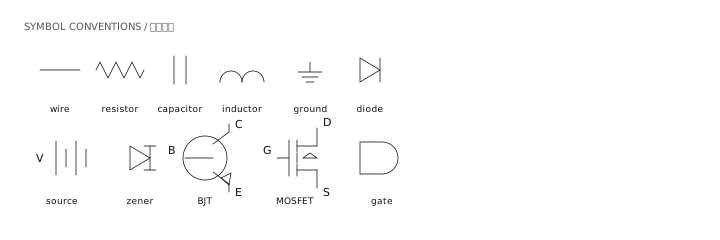
Each entry carries one schematic plate drawn in a fixed notation: symbol outlines follow IEEE/ANSI practice, strokes are hairlines, and nothing is shaded or coloured. The plates are generated as vector files from the same source data as the text, so a change to a component value is reflected in the drawing on the next build. No stock photography and no decorative illustration is used anywhere on the site.
Editorial rules
Entries are written from standard device physics and from the relations found in general reference works on circuit theory. Numbers used in worked examples are checked by hand. Where a result depends on a part's datasheet — a forward voltage, a thermal resistance, a tolerance — the entry says so instead of presenting a single figure as universal.
Scope
The shelf covers component-level fundamentals: passive components and the laws that constrain them, semiconductor devices, digital logic, power conversion, and signal measurement. It deliberately does not cover board layout, regulatory compliance, mains wiring, or firmware; a reader looking for those will find more use in a specialised source.
Safety
Everything here is informational and aimed at low-voltage bench work. Worked examples assume supplies at or below a few tens of volts. Nothing on this site is a substitute for the safety instructions that come with a piece of equipment, for local electrical codes, or for the judgement of a qualified engineer. If you are working on mains voltages or on a battery pack capable of high fault current, stop and get supervision from someone qualified.
本页另有中文版:/zh/about。