OhmPediaDigital LogicBoolean Algebra
Boolean Algebra
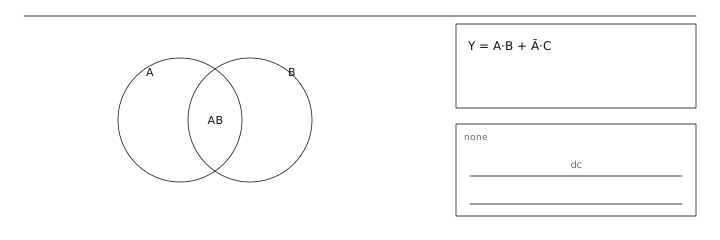
布尔代数 Y = A·B + Ā·C
- Symbol
- Y = A·B + Ā·C
- Unit
- operands ∈ {0, 1} · operators AND, OR, NOT, XOR
- Section
- Digital Logic
- Published
- 2026-09-05
- Author
Boolean algebra defines operations on variables that can take only the values 0 and 1. AND behaves like multiplication, OR like addition, and NOT like complement, with the extra identities A·Ā = 0 and A + Ā = 1 that have no analogue in ordinary arithmetic.
The algebra of two-valued variables that underlies every digital circuit.
The identities worth memorising
Most simplification is done with a handful of rules applied in the right order. Absorption and the distributive law do most of the work; the redundancy theorem (also called consensus) is what removes the term that is causing a glitch.
| Name | Form | Why it matters |
|---|---|---|
| Identity | A + 0 = A · 1 = A | Removes constants |
| Idempotent | A + A = A · A = A | Merges duplicate terms |
| Complement | A + Ā = 1 · A·Ā = 0 | Eliminates a variable entirely |
| Absorption | A + A·B = A · A(A + B) = A | Removes redundant terms |
| Distributive | A(B + C) = AB + AC | Converts between forms |
| Consensus | AB + ĀC + BC = AB + ĀC | Removes the glitch-prone term BC |
SOP, POS and why both exist
Any function can be written as a sum of products (OR of ANDs) or a product of sums (AND of ORs). A two-level NAND-NAND network implements sum of products directly; a NOR-NOR network implements product of sums. Which form is cheaper depends on whether the function has more ones or more zeros in its truth table, so both forms are kept in the toolbox.
- Canonical sum of products: one product term per truth-table row whose output is 1.
- Canonical product of sums: one sum term per row whose output is 0.
- Minterm index is the binary value of the inputs for a 1 row; maxterm index is the value for a 0 row.
- A function of n variables has at most 2ⁿ minterms, and its inverse has exactly the ones it does not have.
Don't-care terms and practical minimisation
Real designs often contain input combinations that cannot occur, or whose output does not matter. Marking those as X in the truth table lets the minimiser treat them as either 0 or 1, whichever gives fewer terms. A decoder driving a seven-segment display is the classic example: input codes 10 through 15 never appear, so the minimised logic for each segment can exploit them.
Where the algebra meets physics
Boolean algebra assumes gates switch instantly and simultaneously. When two paths to the same gate have different delays, a term that the algebra says is redundant — the consensus term BC above — is exactly the term that suppresses the resulting glitch. So there is a real tension: the minimised expression is cheaper and smaller, the non-minimised one is glitch-free in that particular case.
Minimise Y = ĀB̄C + ĀBC + AB̄C + ABC. Group the first two terms: ĀC(B̄ + B) = ĀC. Group the last two: AC(B̄ + B) = AC. So Y = ĀC + AC = C. The eight-row truth table confirms it: in every row where C is 1 the output is also 1. A design that stopped at the four-term form would need four three-input AND gates and one four-input OR gate; the minimised form needs no gates at all. Now consider the glitch: if the original circuit had been Y = ĀC + AC built with real gates, then when A changes with C held high, both terms can be momentarily 0 and the output glitches low for the inverter delay — the reason the consensus theorem matters.
Adjacent entries
- Logic Gate 逻辑门
Off the shelf
Sources
- Physics LibreTexts https://phys.libretexts.org/Bookshelves/University_Physics/University_Physics_(OpenStax)/University_Physics_II_-_Thermodynamics_Electricity_and_Magnetism_(OpenStax)
- NIST https://www.nist.gov/pml/owm/si-units-electric-current