OhmPediaSemiconductor DevicesDiode
Diode
二极管 I = I_S (e^(V/nV_T) − 1)
- Symbol
- I = I_S (e^(V/nV_T) − 1)
- Unit
- V_T ≈ 25.85 mV at 300 K · n = 1…2 · I_S in pA…nA
- Section
- Semiconductor Devices
- Published
- 2026-08-23
- Author
A diode is a PN junction whose current is an exponential function of forward voltage. In the forward direction conduction begins sharply above the knee; in reverse it blocks until the reverse rating is exceeded. The exponential makes it a switch, a clamp, a reference and a detector, depending on how it is biased.
A two-terminal junction that conducts in one direction once the forward voltage exceeds about 0.6 V.
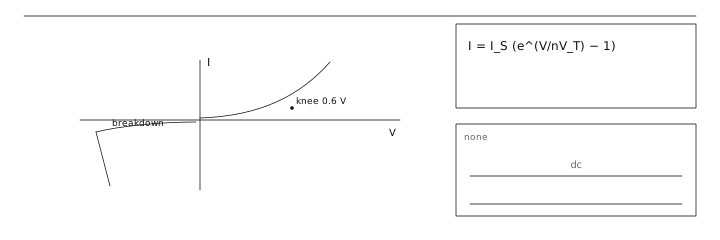
The exponential, and what 60 mV buys
Forward current rises by roughly a factor of ten for every 60 mV of added forward voltage at room temperature. That is why the forward drop stays near 0.7 V over five decades of current, and also why it is not a constant: a diode carrying 10 mA drops about 0.70 V, the same part at 10 µA drops about 0.46 V. Any circuit that treats 0.7 V as exact will be wrong by tens of millivolts at low current.
Families and where each is used
The forward drop and the reverse recovery time are the two numbers that decide the family.
| Type | V_F at rated I | Reverse recovery | Typical use |
|---|---|---|---|
| Silicon PN (1N400x) | 0.9 – 1.1 V | 2 – 30 µs | 50/60 Hz rectification |
| Schottky (1N581x) | 0.3 – 0.5 V | Effectively zero | Switch-mode freewheel, low-drop ORing |
| Fast / ultrafast PN | 1.0 – 1.4 V | 50 – 200 ns | High-frequency rectification |
| Small-signal signal diode | 0.7 V at 10 mA | ≈ 4 ns | Clamps, detectors, logic |
Reverse breakdown is not always fatal
Exceeding the reverse voltage rating in an ordinary rectifier destroys it, but there are two designed exceptions: the Zener diode, which operates in controlled breakdown as a reference, and the avalanche diode, which is built to survive repetitive pulses as a transient clamp. In both cases the important rating is the power the junction can dissipate, not the breakdown voltage itself.
Switching behaviour
A forward-biased PN junction holds stored minority charge. To turn it off, that charge must be removed first, so the diode continues to conduct in reverse for a short interval — reverse recovery. At 50 Hz this costs microseconds out of 10 ms and can be ignored; at 500 kHz it costs microseconds out of 2 µs and dominates both loss and EMI. That is why switchers above a few tens of kilohertz use Schottky or synchronous rectification.
A 12 V supply feeds a red LED and a 470 Ω resistor through a silicon diode in series. The silicon diode drops about 0.68 V at the resulting current, and the LED about 1.9 V, leaving 9.42 V across the resistor and a current of 20 mA. Raise the supply to 24 V and the current roughly doubles to 40 mA, because the two diode drops barely move — the exponential keeps them within about 40 mV over that range. That near-constant drop is exactly what makes diodes usable as references and exactly why they make poor current limiters.
Off the shelf
Sources
- University of Mississippi http://www.phy.olemiss.edu/~cremaldi/PHYS417/DiodeBasics.pdf
- Northern Illinois University https://nicadd.niu.edu/~fortner/course/phys375/lect/p375_05a.pdf
- Physics LibreTexts https://phys.libretexts.org/Bookshelves/University_Physics/University_Physics_(OpenStax)/University_Physics_II_-_Thermodynamics_Electricity_and_Magnetism_(OpenStax)