OhmPediaPassive Components and LawsImpedance
Impedance
阻抗 Z = R + jX
- Symbol
- Z = R + jX
- Unit
- ohms (Ω), complex · |Z| in Ω · phase angle in degrees or radians
- Section
- Passive Components and Laws
- Published
- 2026-09-08
- Author
Impedance is the complex ratio of phasor voltage to phasor current, Z = R + jX. Its real part dissipates energy as heat; its imaginary part, the reactance, stores energy and returns it later. Magnitude and phase together determine both how much current flows and how far out of step it is with the voltage.
The complex generalisation of resistance that also accounts for energy stored and returned by capacitance and inductance.
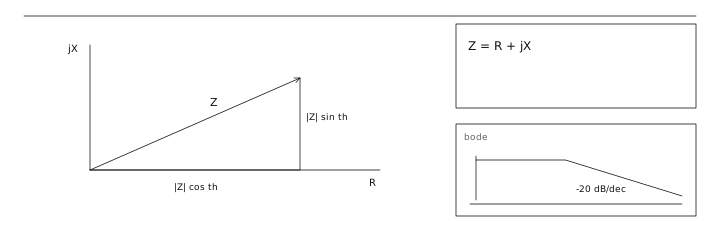
The three element impedances
Each element contributes only one axis. A resistor is purely real at any frequency, an inductor's reactance grows with frequency as +jωL, and a capacitor's falls as −j/(ωC). At one frequency an inductor and a capacitor can present identical magnitudes but opposite signs, which is the basis of every resonance and every filter.
- Resistor: Z = R, real, frequency-independent.
- Inductor: Z = +jωL, magnitude rises 6 dB per octave.
- Capacitor: Z = −j/(ωC), magnitude falls 6 dB per octave.
Series and parallel in the complex plane
The combination rules are unchanged — series impedances add, parallel impedances combine as the reciprocal of the sum of reciprocals — but the arithmetic becomes complex, so the result has both a magnitude and a phase. Two impedances in parallel can produce a magnitude smaller than either, or larger, depending on whether their reactances have the same or opposite sign.
Resonance and Q
When an inductor's +jωL exactly cancels a capacitor's −j/(ωC), the impedance of the series combination collapses to the resistance alone. That happens at ω₀ = 1/√(LC). The sharpness of the effect is the quality factor Q = ω₀L/R, which for a series circuit is also the ratio of stored energy to energy lost per radian.
| L | C | f₀ | Q (with 1 Ω series R) |
|---|---|---|---|
| 100 µH | 100 pF | 1.59 MHz | 1000 |
| 100 µH | 100 nF | 50.3 kHz | 31.6 |
| 10 mH | 100 nF | 5.03 kHz | 316 |
| 1 µH | 1 µF | 159 kHz | 1.0 |
Why phase matters in practice
A load with a large reactive component draws current that does not line up with the voltage, so the product V · I overestimates the useful power and the wiring must still carry the larger current. This is why power factor correction exists, and why a motor's rated current is quoted at a stated power factor rather than at a stated impedance.
A 100 µH inductor with 5 Ω of winding resistance is measured at 100 kHz. Its reactance is 2π × 100 000 × 0.0001 = 62.8 Ω, so the impedance is 5 + j62.8 Ω with a magnitude of 63.0 Ω and a phase of 85.4° — very nearly a pure inductor. At 100 Hz the reactance is only 0.063 Ω, the impedance is 5.0 Ω at 0.7°, and the part behaves as a resistor. That single example explains why the same choke filters a switching supply and does nothing for mains hum.
Read first
- Resistance 电阻
- Capacitance 电容
Adjacent entries
- Resistance 电阻
Off the shelf
Sources
- LibreTexts College Physics https://phys.libretexts.org/Courses/Georgia_State_University/GSU-TM-Introductory_Physics_II_(1112)/08:_Electromagnetic_Induction_AC_Circuits_and_Electrical_Technologies/8.04:_RLC_Series_AC_Circuits
- NDT Resource Center https://www.nde-ed.org/Physics/Electricity/ohmslaw.xhtml
- Physics LibreTexts https://phys.libretexts.org/Bookshelves/University_Physics/University_Physics_(OpenStax)/University_Physics_II_-_Thermodynamics_Electricity_and_Magnetism_(OpenStax)