OhmPediaPassive Components and LawsResistance
Resistance
电阻 R = ρ · l / A
- Symbol
- R = ρ · l / A
- Unit
- ohms (Ω) = volts per ampere · ρ in Ω·m · l in m · A in m²
- Section
- Passive Components and Laws
- Published
- 2026-08-19
- Author
Resistance is the ratio of the voltage across an element to the current through it, R = V / I. Physically it comes from collisions between charge carriers and the lattice, which is why it increases with temperature in metals and usually decreases with temperature in semiconductors.
The property of a material that converts electrical energy to heat at a rate proportional to the square of the current.
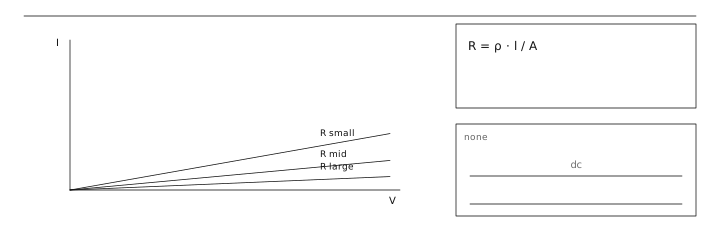
Geometry and resistivity
For a uniform conductor, R = ρ · l / A. Doubling the length doubles the resistance; doubling the cross-section halves it. Resistivity ρ is the material constant: copper is about 1.68 × 10⁻⁸ Ω·m at 20 °C (per Physics LibreTexts), nichrome about 1.1 × 10⁻⁶ Ω·m, and ordinary carbon about 3.5 × 10⁻⁵ Ω·m. That six-decade spread is why the same geometry can be a busbar or a heating element.
Temperature coefficient
Metals have a positive coefficient of roughly +0.4 %/K for copper and +0.0039/K for aluminium, so a winding that measures 10 Ω cold reads about 13 Ω at 100 °C. This matters twice: in motor and transformer protection, and in precision circuits where a resistor's own self-heating shifts the value it is supposed to set.
| Material | ρ at 20 °C (Ω·m) | Temp. coefficient | Typical use |
|---|---|---|---|
| Copper | 1.68 × 10⁻⁸ | +0.39 %/K | Wire, PCB traces, windings |
| Nichrome 80/20 | 1.1 × 10⁻⁶ | +0.04 %/K | Heating elements, dummy loads |
| Carbon film | ≈ 3.5 × 10⁻⁵ | −0.02 %/K | General purpose, cheap |
| Manganin | 4.8 × 10⁻⁷ | ±0.0015 %/K | Current shunts, standards |
How a real resistor deviates
A resistor's datasheet limits three independent errors. Tolerance is the spread at 25 °C — 1 % is standard, 0.1 % available at a price. Temperature coefficient describes how far the value moves over the operating range. And the power coefficient, rarely quoted, describes the shift caused by the part's own heating. For a 100 ppm/°C part used over a 60 K rise, the temperature term alone contributes 0.6 %, six times the effect of a 0.1 % tolerance on a short-term measurement.
Series and parallel
Resistances in series add directly. In parallel the reciprocals add, and two equal values give exactly half. The general two-resistor form R = R₁R₂ / (R₁ + R₂) is worth memorising because it appears in every divider, feedback network and termination calculation.
A 24 V, 500 mA load must be fed from a resistor to drop 24 V to 12 V. R = 12 / 0.5 = 24 Ω, but the resistor dissipates 12 × 0.5 = 6 W, so a 10 W wirewound part is needed and it will run hot. Compare with a 0.1 Ω current shunt carrying 5 A: the drop is 0.5 V and the dissipation is 2.5 W, which in an 0.1 % tolerance manganin part with a 15 ppm/°C coefficient means the reading drifts by only 0.09 % over a 60 K rise — the reason shunts are made from manganin rather than copper.
Read first
- Ohm's Law 欧姆定律
Adjacent entries
Off the shelf
Sources
- Physics LibreTexts https://phys.libretexts.org/Bookshelves/University_Physics/University_Physics_(OpenStax)/University_Physics_II_-_Thermodynamics_Electricity_and_Magnetism_(OpenStax)
- California Institute of Technology https://leech.caltech.edu/cntl/?page_id=317
- NDT Resource Center https://www.nde-ed.org/Physics/Electricity/ohmslaw.xhtml