OhmPediaSignal and MeasurementDecibel
Decibel
分贝 dB = 20 log₁₀(V₂/V₁)
- Symbol
- dB = 20 log₁₀(V₂/V₁)
- Unit
- dB (dimensionless) · 10 log₁₀ for power ratios · dBm references 1 mW
- Section
- Signal and Measurement
- Published
- 2026-08-27
- Author
A decibel is one tenth of a bel, defined as ten times the logarithm of a power ratio. For voltages measured across the same impedance the factor becomes twenty, because power is proportional to voltage squared. The decibel is a ratio, not a unit; only when a reference is appended — dBm for 1 mW, dBV for 1 V — does it denote an absolute level.
A logarithmic ratio used to express gain, loss or level, so that multiplication becomes addition.
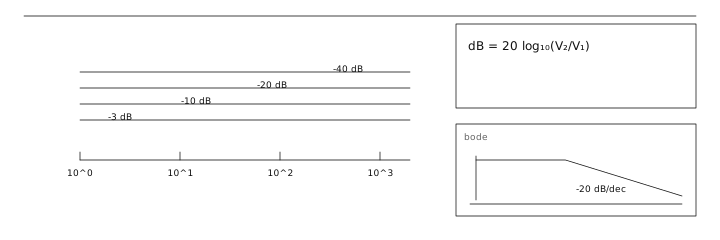
The numbers worth memorising
Because the scale is logarithmic, a few anchor values cover most practical work. Everything else is built from them by combination.
| Power ratio | Voltage ratio | dB |
|---|---|---|
| 0.5 | 0.707 | −3 |
| 0.25 | 0.5 | −6 |
| 0.1 | 0.316 | −10 |
| 1 | 1 | 0 |
| 2 | 1.414 | +3 |
| 4 | 2 | +6 |
| 10 | 3.16 | +10 |
| 100 | 10 | +20 |
Why engineers keep using it
Three reasons. Cascade arithmetic becomes addition, so a receiver chain of −2 dB, −1.5 dB and −3 dB is simply −6.5 dB rather than a chain of multiplications. The ear and the eye are roughly logarithmic, so a linear scale hides the information that matters. And the range is enormous — a system that spans 120 dB of dynamic range would need a seven-decade linear axis to display on one graph.
The 3 dB and 6 dB rules
−3 dB is half power and 0.707 in voltage, which is the definition of a filter's cutoff frequency. +6 dB is double the voltage, and it corresponds to a single-pole slope of 6 dB per octave — 20 dB per decade in the frequency domain, or 20 dB per decade of rising gain in an amplifier's roll-off. Confusing the power and voltage factors is the single most common decibel error: a stage described as "6 dB gain" usually means double the voltage, not four times the power.
Absolute levels: dBm, dBV, dBu
Attach a reference and the decibel becomes an absolute level: 0 dBm is 1 mW, 0 dBV is 1 V RMS, 0 dBu is 0.775 V RMS (the voltage that produces 1 mW in 600 Ω). A −90 dBm signal in a 50 Ω system is about 7 µV RMS, which is a useful number to know when reading a spectrum analyser screen or a receiver sensitivity specification.
A radio receiver has an antenna feed of −95 dBm, a 12 dB gain low-noise amplifier, a 3 dB loss filter, a 20 dB gain mixer and a 6 dB loss cable to the detector. Sum the decibels: −95 + 12 − 3 + 20 − 6 = −72 dBm at the detector, which in 50 Ω is 10^(−72/10) = 63 pW, or √(0.000000000063 × 50) = 56 µV RMS. The same calculation in linear terms would multiply five gains and losses, one of which is a factor of 10^(−9.5) — the reason nobody does it that way.
Adjacent entries
- Electric Power 电功率
Off the shelf
Sources
- Physics LibreTexts https://phys.libretexts.org/Bookshelves/University_Physics/University_Physics_(OpenStax)/University_Physics_II_-_Thermodynamics_Electricity_and_Magnetism_(OpenStax)
- LibreTexts College Physics https://phys.libretexts.org/Courses/Georgia_State_University/GSU-TM-Introductory_Physics_II_(1112)/08:_Electromagnetic_Induction_AC_Circuits_and_Electrical_Technologies/8.04:_RLC_Series_AC_Circuits
- NIST https://www.nist.gov/pml/owm/si-units-electric-current